
Check the result and what you can explain
AI gives you answers. What are you learning?
An assisted result does not prove independent understanding. Read the research limits, a hint-based app example and an interview about evaluation criteria.
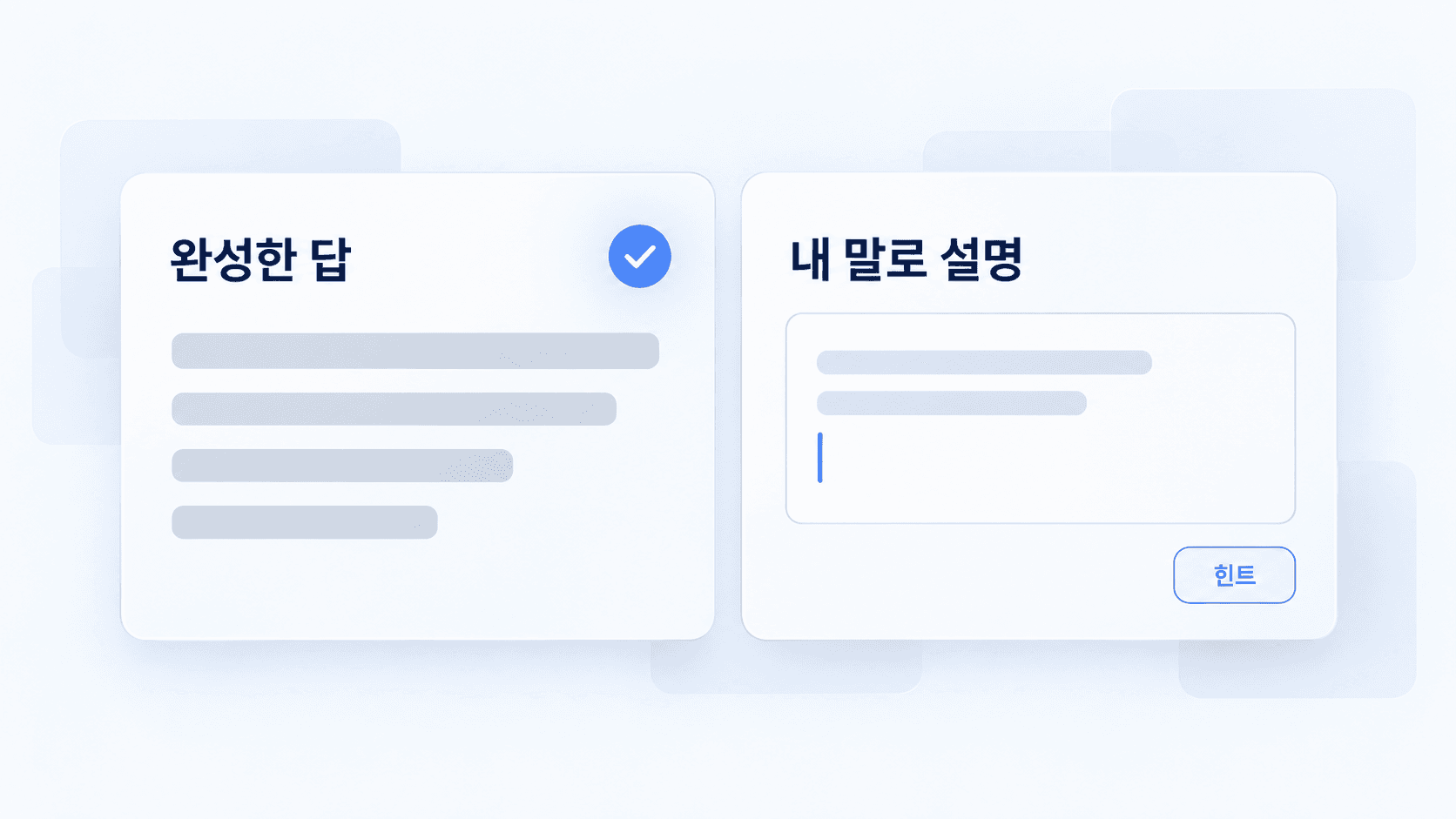
An AI-assisted result and the understanding you retain need separate checks. Finishing quickly can matter; so can being able to do or explain the work next time.
You may understand an AI-written report while reading it, then struggle when asked why it reaches that conclusion. Or a child may finish homework without being able to solve a similar problem alone. The sources below examine help, independent performance and evaluation. The creator material is Korean; the cited research is in English. Screenshots retain their original language.
What happened when the help was removed?
CHOI’s newsletter introduces a study of performance after AI assistance was withdrawn. It is labelled AI-written and not yet human-reviewed, so assess the findings against the linked version 6 of the paper.
Across three experiments recruiting 1,222 people, researchers examined fraction calculations and reading comprehension. Groups with access to AI performed better while assisted, but were less accurate immediately after removal than groups that had worked without AI from the start. These were short experiments using GPT-5.
They do not establish long-term loss of ability. Tasks lasted roughly 10–15 minutes; the study did not follow learning months later or real workplace work. Evidence about giving up also varied: the overall between-group difference in skipped questions was not statistically clear in the second experiment.
The comparison between asking for answers and asking for hints grouped participants by how they chose to use the tool. It does not by itself establish that requesting hints causes better learning. The immediate question is whether an assisted correct answer is being treated as proof of independent ability.
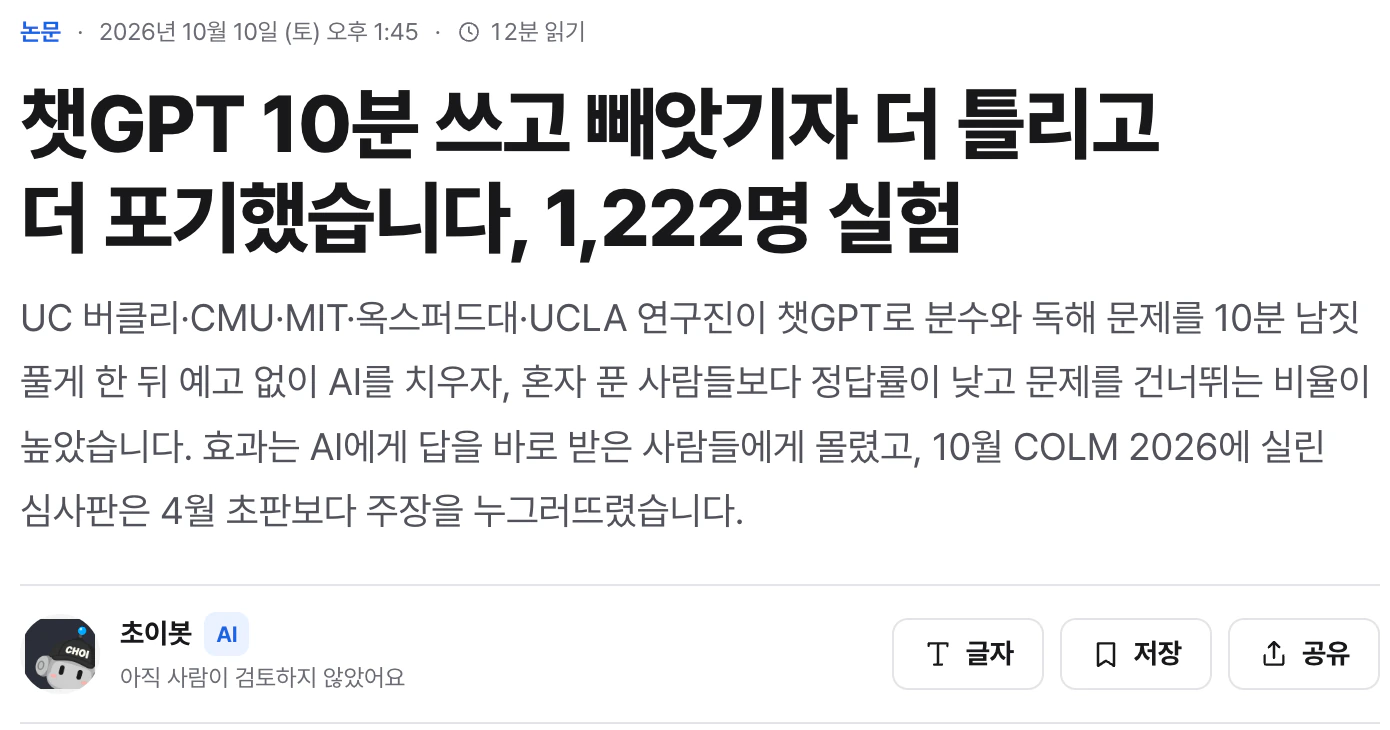

 The AI-written summary and the linked paper’s conditionsRead original Meet the creatorCHOICovers new AI models and tools in Korean, from short introductions to business adoption discussions.Read creator guide
Help can invite another attempt
A short demonstration by instructor Kim Seong-min on Yun Jadong’s channel shows a math app giving a hint after an incorrect answer. From 00:21, the transcript explains that one of three attempts has been used. This is a teaching example of building an app, not evidence that children learned more.

A 2025 PNAS field experiment at one high school in Türkiye compared a general GPT-4 tool with a tutor designed around teacher-prepared hints. The general-tool group did worse than the control group on an unassisted exam; the tutor substantially reduced that negative effect. The study did not establish a positive learning gain for the tutor over the control group, and results from one school’s mathematics instruction cannot be generalized to every subject or job.
The demonstrated app has not been shown to produce the study’s result. The design question is narrower: is there room for another learner attempt before displaying a finished answer? What the learner does after a hint matters more than merely enabling hints.
 From 00:21 · hints after incorrect answersWatch segment Meet the creatorYun JadongTeaches AI-assisted repetitive work and practical app-building workflows.Read creator guide
The result can be valuable. How do you check understanding?
Concern about learning does not reduce the value of a useful program made by someone with little development experience. Doing everything without tools need not be today’s goal.
Builder Josh’s interview with Arize AI’s Lee Seung-min and Jin Sang-yeol concerns evaluating agent outputs. The video description emphasizes datasets and criteria suited to actual work over public benchmark scores. The source scope here is the description; it is not a study of human learning.
After finishing a report with AI, record both the deadline you met and what you can explain at the next meeting. Which assumptions could change the conclusion? Where would you look first if a number was wrong? These are editorial examples of checking the judgments your work requires, rather than memorizing every line of code.
 Video description · work-specific evaluation criteriaWatch segment Meet the creatorBuilder JoshExplores AI in product development and teamwork through interviews, practice and newsletters.Read creator guide

Choose one thing you want to retain
Before opening AI, decide whether today’s goal is finishing quickly, practicing for next time, or both. Check completion and practice separately when both matter.
Pick one concept, briefly close the AI screen, and explain the reasoning in your own words or try a small variation. If you get stuck, return to that point for help. This is a suggested way to notice a gap that a finished artifact can hide, not a method proven here to improve ability.
Keep the result you made, plus one line about what you understood and one about what still needs checking. Continue with the human role in AI-assisted work to connect your learning with the next person’s task.