
Separate analysis from permission to reuse
Can you release an app built after analyzing another?
Check permission for analysis, AI input, development and sale separately. This guide explains the South Korean copyright scope and the limits of a REA experiment.
Before using REA to analyze another app and build a product, establish what is permitted at each step: analysis, input to AI, development, distribution and sale. Pause AI input while that permission or legal basis remains unclear. Newly generated code does not remove the need for this check.
This guide discusses South Korean copyright law, using the Korean article’s October 15, 2026 source scope. It is not a clearance decision for an individual app or other jurisdictions.
REA, short for Reverse Engineer Anything, is an open-source tool that connects to AI agents to analyze applications, executables and runtime behavior. Permission to inspect an app and permission to use the findings in a product are separate questions.
When might development be permitted?
If the rightsholder or applicable terms permit the relevant analysis, AI input and new-product work, proceed only within those terms. Check distribution and sale, plus conditions on third-party code and images. See Article 46 of South Korea’s Copyright Act.
You can also encounter a functional idea through ordinary use and implement it independently—for example, deciding that automatic document saving would be helpful, then creating your own code and interface without using the original code or reverse-engineering information. This concerns the copyright distinction between ideas and expression, not automatic permission to reuse REA output. See Article 101-2.
A narrow statutory exception concerns interoperability: making independently created programs work together, such as opening another program’s file format. The conditions include lawful entitlement to use the program, necessary interoperability information not being readily available, and analysis being unavoidable and limited to the necessary parts.
Information obtained under that exception is restricted to interoperability purposes. Providing it to others is limited to what interoperability requires. It cannot be used to develop, produce or sell a program substantially similar in protected expression, or for other copyright infringement. See Article 101-4.
When should you stop and check first?
- You assume buying an app permits analysis and reuse. Check the relevant terms for each operation.
- You plan to send only an analysis report to AI or rename code elements. Establish permission or another legal basis for protected code and images first.
- You want to use interoperability findings for another purpose. That exception is purpose-limited even if AI rewrites the implementation.
The editorial advice to wait when permission is unclear is distinct from the legal restrictions attached to the interoperability exception.
How did one experimenter approach sale and sharing?
AI Jossi described writing new code rather than taking existing code in a REA experiment post. A reader asked whether the result could be sold.
In a follow-up, the author discouraged slightly modifying an analyzed service and selling it. In a reply about sharing, the author declined to share installers and code bundles out of concern for Hancom’s rights. These Korean posts document personal experiments and judgments, not legal approval.
Analysis does not confer usage rights
REA’s own license and the rights in a target app remain separate. Its official disclaimer explains that receiving an analysis report or source-like output does not grant rights to the original program, data or generated result. It asks users to check target rights and applicable tool terms before sharing or using output in another product.
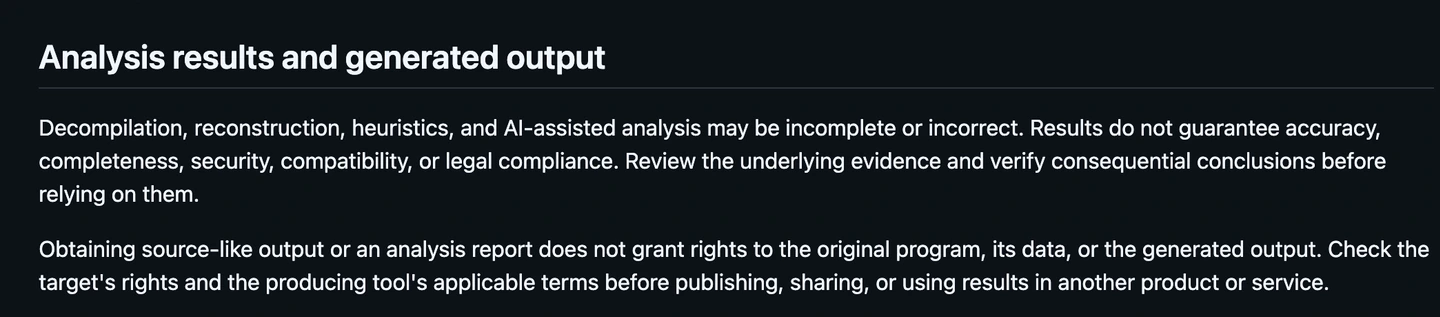

 Selected source discussed in this guideRead original Meet the creatorREA projectREA’s own license and the rights in a target app remain separate.Its official disclaimer explains that receiving an analysis report or source-like output does not grant rights to the original program, data or generated result. It asks users to check target rights and applicable tool terms before sharing or using output in another product.View author profile
Record the permitted scope of analysis, AI input, development and sale for each app, then check the finished product against it before release. For the related question of what an agent can access, continue with API-key storage and exposure checks.
Scope: the Korean source article checked South Korean copyright law and Threads records on October 15, 2026, with the latter captured at 13:17–13:18 KST. No experiment reproduction, professional legal review, individual release approval, or complete terms-of-service, patent, trademark or privacy assessment was obtained. Translation does not extend these conclusions to another jurisdiction; seek qualified advice for a consequential release decision.