
Markets, first customers and team standards
Which startup videos fit your current stage?
Compare EO Korea, BZCF and Alex Hormozi through specific videos. Choose the decision you face and the viewing time you can commit.
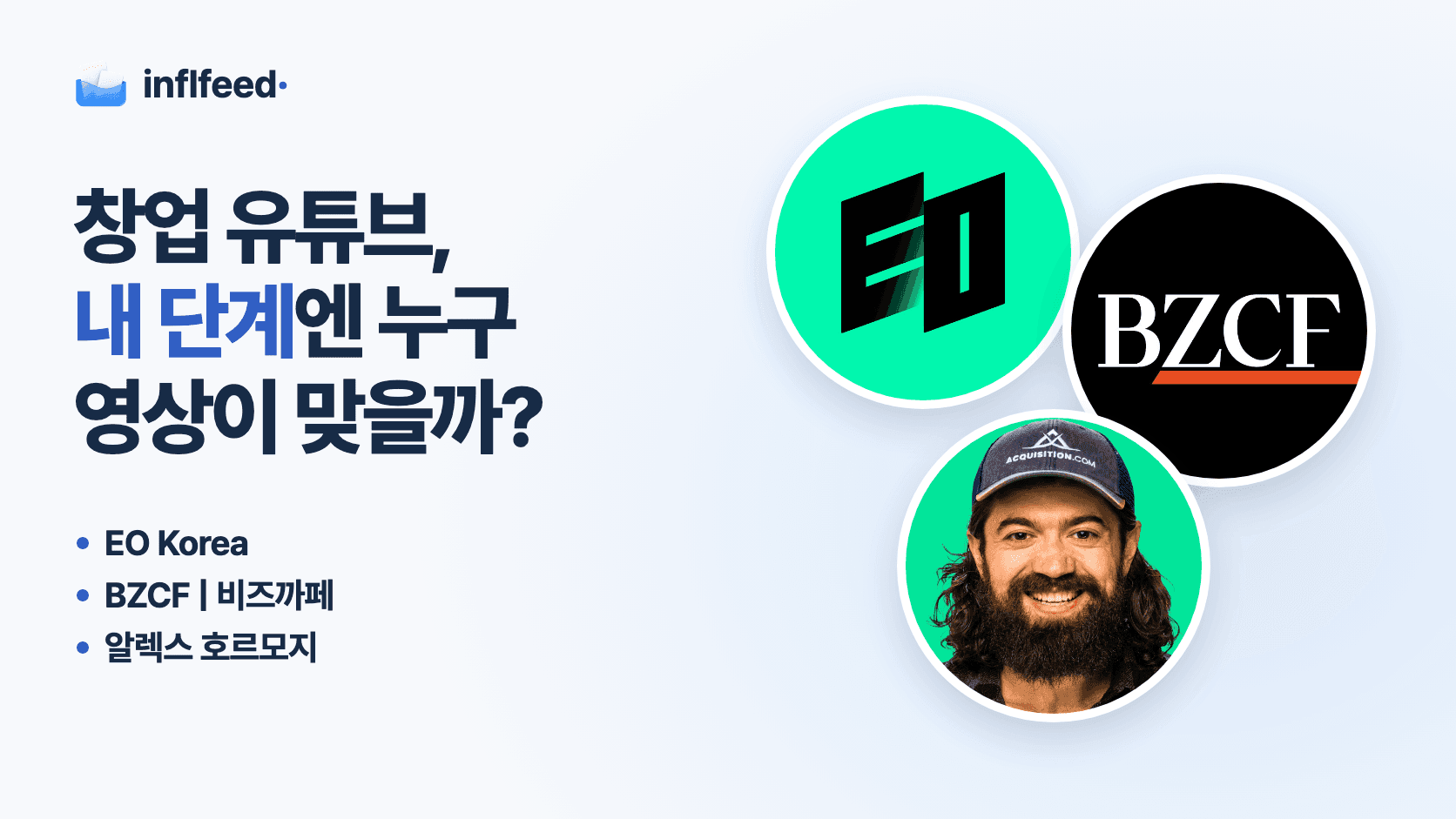
Choose a startup channel by the decision in front of you: EO Korea for markets, BZCF for first customers, or Alex Hormozi for team standards. The recommendation comes from one October 2026 example per channel, not a ranking of founders or business outcomes.
The selected EO and BZCF conversations are in Korean; Hormozi’s selected video is in English. English caption availability for the Korean examples has not been verified. These are specific October 2026 examples, not a claim about every upload on each channel.
Compare the selected examples
Swipe horizontally to compare all columns.
| Channel | Decision discussed | Selected video | Language |
|---|---|---|---|
| EO Korea | Choosing a market | About 16 minutes; start at 10:05 | Korean |
| BZCF | Finding paying customers | About 91 minutes; start at 1:18:46 | Korean |
| Alex Hormozi | Making team standards explicit | About 16 minutes; start at 02:35 | English |
These recommendations concern the linked videos, not measured teaching quality or business outcomes. Their descriptions also carry promotions: EO’s book, BZCF’s company and hiring links, and Hormozi’s roadmap.
EO Korea — examine why a founder chose a market
For someone deciding among ideas, the October 1 EO Library conversation features Affinit CEO Lee Cheol-won and broadcaster and entrepreneur Lucky. Affinit’s Indian fintech journey began with an app for checking prepaid-phone balances. The episode’s description presents this as a retrospective on finding an overlooked opportunity.
At 10:05, Lee describes three criteria behind his 2014 decision: market size, growth and maturity. He explains the tension between arriving in a crowded market and arriving before demand is ready. Korean captions accompany the discussion, with terms such as NBFC explained separately.
For each idea, write what you know about those three questions. A blank is a research need, not a reason to invent a market estimate. This is an Indian fintech founder’s retrospective, so applying the criteria to a small Korean business may produce different answers.
 10:05 · 16m totalWatch segment Meet the creatorEO KoreaFor someone deciding among ideas, the October 1 EO Library conversation features Affinit CEO Lee Cheol-won and broadcaster and entrepreneur Lucky.Affinit’s Indian fintech journey began with an app for checking prepaid-phone balances. The episode’s description presents this as a retrospective on finding an overlooked opportunity.Read creator guide

BZCF — hear where the first customer effort stalled
The October 16 interview with MarqVision founder Lee In-seop lasts about 91 minutes. BZCF’s description explains its long conversations and minimal editing. MarqVision began with a service detecting and removing counterfeit products online.
At 14:27, and again at 1:18:46, Lee estimates that most founders fail to find ten genuinely paying customers outside their personal network. The 90% figure is his estimate, not a measured failure rate established by this article.
At 1:19:20, he recalls early customers being mostly acquaintances, including family friends. A friend’s company paying about KRW 50,000 a month asked for a KRW 10,000 reduction. Even with about 1,000 website visitors in one week and dozens of active users, that request made him question the product’s value and direction. These are the founder’s reported figures and interpretation.
List who pays or uses your product consistently, then distinguish family, friends and known companies from unrelated customers. Visits or signups alone cannot answer that question. MarqVision is a B2B example, so “ten customers” is not a universal threshold for a consumer app.
 1:18:46 · 1h 31m totalWatch segment Meet the creatorBZCFThe October 16 interview with MarqVision founder Lee In-seop lasts about 91 minutes.BZCF’s description explains its long conversations and minimal editing. MarqVision began with a service detecting and removing counterfeit products online.Read creator guide

Alex Hormozi — examine an explicit team standard
Hormozi’s roughly 16-minute October 16 video, “If I could start over in business, I’d do this sooner,” develops one forceful argument about team quality. He describes company culture through what behavior is rewarded and punished at 00:24, and argues at 02:35 that departures send a strong signal.
He clarifies that this is not a proposal to dismiss everyone, then frames the weakest accepted performance as a leader’s minimum standard at 03:44. At 08:23, he claims to judge sales potential in fourteen, or even seven, days, assuming the person has completed training. These are his views, not validated timelines or employment rules.
He acknowledges the harsh tone and says people should be treated respectfully. The ending and first description line promote a free Acquisition.com roadmap.
Use the discussion to define expected work before hiring: one or two sentences about outcomes, plus what you will observe and discuss in the first weeks. Do not turn a US investor’s management opinion into dismissal guidance. Local employment law and procedures still apply, including in South Korea; no legal employment assessment is offered here.
 2:35 · 16m totalWatch segment Meet the creatorAlex HormoziHormozi’s roughly 16-minute October 16 video, “If I could start over in business, I’d do this sooner,” develops one forceful argument about team quality.He describes company culture through what behavior is rewarded and punished at 00:24, and argues at 02:35 that departures send a strong signal.Read creator guide

Choose one channel for your current stage. For the practical step after building a product, read where to find first users and what to observe.
Creators in this guide
- EO KoreaFor someone deciding among ideas, the October 1 EO Library conversation features Affinit CEO Lee Cheol-won and broadcaster and entrepreneur Lucky. Affinit’s Indian fintech journey began with an app for checking prepaid-phone balances. The episode’s description presents this as a retrospective on finding an overlooked opportunity.
- BZCFThe October 16 interview with MarqVision founder Lee In-seop lasts about 91 minutes. BZCF’s description explains its long conversations and minimal editing. MarqVision began with a service detecting and removing counterfeit products online.
- Alex HormoziHormozi’s roughly 16-minute October 16 video, “If I could start over in business, I’d do this sooner,” develops one forceful argument about team quality. He describes company culture through what behavior is rewarded and punished at 00:24, and argues at 02:35 that departures send a strong signal.